









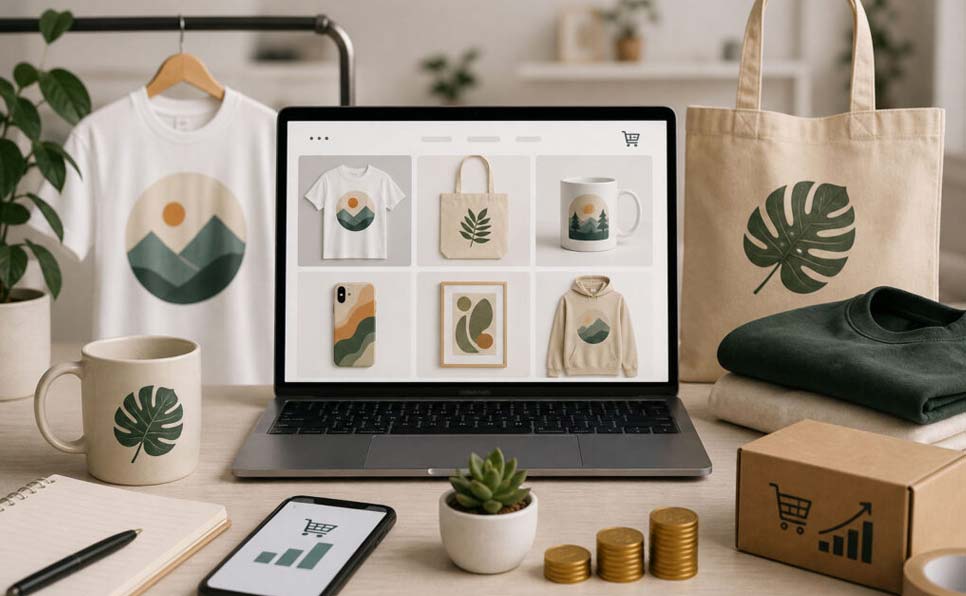

Print on demand (POD) lets you sell custom-designed products without holding any inventory. You design it, a supplier prints it, and they ship it directly to your customer. The global POD market is worth over $12 billion in 2026 and growing fast. This guide walks you step by step through how to pick a niche, set up your store, create designs, and start making money, even if you’re starting from zero.
Imagine waking up to a notification that says you just made money while you were sleeping. No warehouse. No shipping boxes. No upfront investment. That’s what print on demand (POD) can look like when you do it right.
Print on demand is one of the most beginner-friendly ways to make passive income online in 2026. You create the designs. A print partner handles everything else: production, packaging, and shipping. When a customer buys your product, you earn the profit automatically.
The market is booming. According to Precedence Research, the global print on demand market was worth $12.96 billion in 2025 and is expected to hit $118.85 billion by 2035. That’s nearly a 25% growth every single year. The demand for personalized, unique products is growing fast, and there’s real room for beginners to tap in.
In this beginner’s guide, you’ll learn exactly how print on demand works, how to pick a profitable niche, which platforms to use, and how to grow your store into a reliable passive income stream in 2026.
What Is Print on Demand and How Does It Work?
Print on demand is a zero-inventory business model where you upload custom designs to a platform, which then prints and ships products directly to customers whenever someone places an order. You only pay for the item after a sale, which means you’re never stuck with unsold stock.
Here’s the simple flow:
You don’t touch the product at all. Once your listings are live and getting traffic, the process runs on autopilot. That’s what makes POD one of the best passive income ideas for beginners who don’t want to deal with logistics.
Is Print on Demand Still Worth It in 2026?
Yes, and the numbers back it up. According to Printful, there are over 228,000 active POD stores globally. The market is growing at a 26% compound annual growth rate (CAGR), meaning it’s one of the fastest-growing segments in all of eCommerce.
What does this mean for you? The opportunity is real, but so is the competition. The sellers winning in 2026 aren’t just throwing generic designs on t-shirts and hoping for the best. They’re picking specific niches, creating designs that speak directly to a tight audience, and building brands that feel personal.
The truth about earnings: most beginners earn $100 or less per month in their first few months. Growing stores hit $1,000 to $3,000 per month. Established stores with strong brands can reach $10,000 or more. It’s not a get-rich-quick scheme. But it is a very real way to build passive income if you treat it like a business.
How Do You Pick a Profitable Niche for Print on Demand?
A niche is the specific audience or theme your products are built around. The biggest mistake beginners make is picking something too broad, like ‘dog lovers’ or ‘fitness.’ Those aren’t niches; they’re categories. Real niches are specific enough that a customer looks at your product and thinks: ‘This was made for me.’
The best way to find your niche is to combine an identity (who someone is) with an interest (what they care about). For example:
-
- Nurse + Horror movies = ‘Night Shift Vibes’ scrubs-themed designs
-
- Retired + Gardening = ‘I’m retired, my garden isn’t’ home decor
-
- Dog owner + Hiking = ‘My hiking buddy has four legs’ outdoor gear
-
- Teacher + Coffee = ‘Surviving parent-teacher conferences since 2015’ mugs
In 2026, the most profitable print on demand niches include pets, fitness, mental health, home decor, and profession-based gifts. These work because they have passionate, specific audiences who love to buy products that represent who they are.
A quick way to validate your niche: go to Etsy, type your niche phrase into the search bar, and look at the autocomplete suggestions. If Etsy suggests it, people are searching for it. Then look at the top results. If the designs are all generic or low quality, that’s your opening.
Which Platform Should You Use to Sell Print on Demand Products?
Etsy is the best starting platform for most beginners because it has built-in traffic. As of early 2026, Etsy has over 91 million active buyers already looking for unique, personalized products. You don’t have to drive traffic from scratch.
Here’s a quick comparison to help you choose:
| Platform | Best For | Key Note |
|---|---|---|
| Etsy | Beginners, built-in traffic | ~10% total fees per sale |
| Shopify | Brand building, scaling up | You drive your own traffic |
| Redbubble | Artists, no upfront setup | Lower margins, less control |
| Amazon Merch | Huge reach, passive traffic | Invite-only, competitive |
Recommendation: Start with Etsy + Printify. Printify connects directly to Etsy, has over 1,300 products in its catalog, and its free plan is enough to get started. Once you’re making consistent sales, consider adding a Shopify store to build your brand independently.
How Do You Create Designs If You’re Not an Artist?
You don’t need to be an artist to succeed in print on demand. In fact, some of the best-selling POD products have very simple designs: a clean quote, a bold phrase, or a minimalist illustration. What matters is that the design speaks to your specific audience.
Here are the tools beginners actually use:
-
- Canva (free) – drag-and-drop design tool, perfect for text-based designs and simple graphics
-
- Kittl – great for vintage and retro-style designs with professional templates
-
- Adobe Firefly – AI image generation for creating unique artwork
-
- Printify’s built-in design tool – works directly inside your product creator
A few design tips that actually work:
-
- Keep it simple. One or two colors outperform complex multicolor designs in most categories.
-
- Think about what your audience would want to wear or display proudly, not just what looks cool to you.
-
- Use black, white, navy, and grey as base colors. They’re universally popular.
-
- Order a physical sample before you start promoting your product. What looks good on screen doesn’t always look the same in print.
What Profit Margins Can You Actually Expect?
Let’s talk real numbers. A healthy print on demand profit margin sits between 20% and 35% net after production costs, shipping, and platform fees. Some sellers hit 40% to 50% on premium or personalized products, but that’s the exception, not the norm when you’re starting out.
Here’s a real example for a custom t-shirt on Etsy:
-
- Selling price: $25.00
-
- Production cost (via Printify): $9.00
-
- Etsy fees (listing + transaction + payment): ~$3.00
-
- Shipping charge (passed to buyer): $0
-
- Your profit: ~$13.00 (52% gross, ~25% net after platform overhead)
Wall art and home decor items tend to have higher margins than basic t-shirts. A canvas print that costs $15 to produce can sell for $45 to $80. That’s why experienced sellers often expand beyond apparel once they’re comfortable.
The key rule: never compete on price. If your design is strong and your niche is right, people will pay a fair price. Sellers who try to undercut the market usually end up working hard for almost no profit.
How to Start Your Print on Demand Business: A Step-by-Step Guide
Here’s the exact roadmap to go from zero to your first sale:
Step 1: Pick Your Niche
Use the identity + interest formula described above. Validate it on Etsy by checking search autocomplete and looking at competitor listing quality. If designs look outdated or generic, you can win.
Step 2: Sign Up for a POD Supplier
Create a free account on Printify or Printful. Both integrate directly with Etsy. Printify has a larger catalog and more competitive pricing; Printful has slightly better print quality and branding options.
Step 3: Open Your Etsy Store
Go to Etsy.com/sell and create your seller account. Choose a shop name that reflects your niche. During setup, add a temporary placeholder listing to activate your store, and add your POD provider as a production partner. Etsy requires this disclosure.
Step 4: Create Your First 10 to 20 Products
Don’t launch with just one or two products. Aim for 10 to 20 listings in your first month. More listings means more chances to show up in search results. Focus on variety within your niche: different product types, design styles, and color combinations.
Step 5: Optimize Your Listings for Etsy SEO
Etsy is a search engine. Use keyword-rich titles, descriptions, and tags. Think like a buyer: what would you type to find your product? Put your most important keywords at the beginning of your title. Use all 13 tags available on every listing.
Step 6: Drive Traffic with Free Methods
Pinterest is one of the most powerful free traffic sources for POD sellers. Post your product mockups as pins with keyword-rich descriptions. TikTok is another growing channel where showing your design process or behind-the-scenes content builds an audience fast.
Step 7: Analyze, Improve, Repeat
After 30 days, check which listings have views and which are getting clicks. Double down on what’s working. Kill what isn’t. Add 5 to 10 new designs every week. The sellers who grow consistently are the ones who treat this as an ongoing process, not a one-time setup.
Start Small, Think Long-Term
Print on demand is one of the most accessible ways to start a passive income business in 2026. The startup cost is nearly zero. You don’t need design experience. You don’t need technical skills. What you do need is consistency, a specific niche, and a willingness to learn as you go.
Here are the three things to remember:
-
- Niche down as specifically as possible. Generic designs don’t sell. Targeted designs do.
-
- Publish consistently. The more products you have, the more chances you have to make a sale.
-
- Be patient. Most successful POD sellers took 6 to 12 months before they hit consistent income.
The global POD market is growing, buyers want personalized products, and the tools to get started are free. The only thing standing between you and your first sale is action. Start today, learn as you go, and build something that works for you around the clock.
Frequently Asked Questions
1. How much money do I need to start a print on demand business?
You can start for free. Both Etsy and Printify have free plans. Etsy charges a small listing fee of $0.20 per product, but you only pay for production after a customer buys. Many beginners launch their first store with less than $20.
2. Do I need design skills to sell print on demand products?
Not at all. Tools like Canva make it easy to create professional-looking designs with no experience. Text-based designs (quotes, phrases, names) are consistently some of the best sellers. If you can type words and pick a font, you can create designs that sell.
3. How long does it take to make money with print on demand?
Most beginners see their first sale within 30 to 90 days of launching with optimized listings. Building consistent passive income typically takes 6 to 12 months of consistent effort. The key is to keep publishing new designs and refining what works.
4. Is Etsy or Shopify better for print on demand beginners?
Etsy is better for beginners because it already has millions of buyers. You don’t need to build your own audience. Once you’re making 50 or more sales per month, adding a Shopify store makes sense for better margins and brand control. Think of Etsy as your testing ground and Shopify as your long-term home.
5. What are the best products to sell for print on demand in 2026?
T-shirts and hoodies are the highest-volume categories, but wall art, mugs, and home decor often have better profit margins. Apparel leads the market at around 40% of all POD sales, but home decor is the fastest-growing segment at a 28% CAGR through 2030. A balanced approach is to start with apparel and test home decor as you grow.